20 October 2026
MSCA Success Stories: BioTrainValue
This article opens a series on successful Marie Skłodowska-Curie projects carried out in Central Poland. It is written for teams already running MSCA grants and for institutions considering an application. We begin with BioTrainValue; more at biotrainvalue.eu.
Since January 2023, the international project BioTrainValue has been coordinated from Łódź. It turns residues from sawmills, pulp mills, olive groves and biogas plants into fuels, chemicals and materials, and trains people who can take the field further.
What is BioTrainValue?
Full title: “BIOmass Valorisation via Superheated Steam Torrefaction, Pyrolysis, Gasification Amplified by Multidisciplinary Researchers TRAINing for Multiple Energy and Products’ Added VALUEs”. The acronym BIO-TRAIN-VALUE reflects the project’s three pillars: biomass valorisation, training a multidisciplinary workforce and creating higher-value products.
The project is funded under Horizon Europe through the Marie Skłodowska-Curie Actions, in the Staff Exchanges scheme. It started on 1 January 2023 and runs until the end of December 2026, with an EU contribution of almost one million euro (EUR 993,600). It is coordinated by Lodz University of Technology (Faculty of Process and Environmental Engineering) and led by Prof. Szymon Szufa.
Staff Exchanges funds mobility rather than equipment: secondments between institutions, countries and sectors. More than 40 people took part in BioTrainValue secondments, for three months on average, and 60% of them were women. Success therefore depends as much on how many researchers have gone through the exchanges, and on the lasting links they leave behind, as on the number of reactors or tonnes of torrefied biomass.
How did the project come about?
BioTrainValue did not start from scratch. The idea grew out of the aim of building a consortium around the torrefaction, pyrolysis and gasification of biomass and waste. To a large extent the project continues Biocarbon, an earlier project funded by the National Centre for Research and Development (NCBR) under the LIDER programme. The coordinator’s career path also helped. After his PhD, Prof. Szufa spent five years in industry, which allowed him to identify and bring in industrial partners, and it is these partners that give the project its intersectoral character.
The road to the grant was long. The proposal was submitted to the Environmental and Geosciences (ENV) panel and was funded on the third attempt, in the 2021 call, even though the team had no previous experience of coordinating MSCA projects. Support from the university proved useful at the writing stage, especially in the sections on gender equality and on participant training and education. This is a fairly typical story: a good MSCA project often matures over several calls.
The consortium: science and industry from seven countries
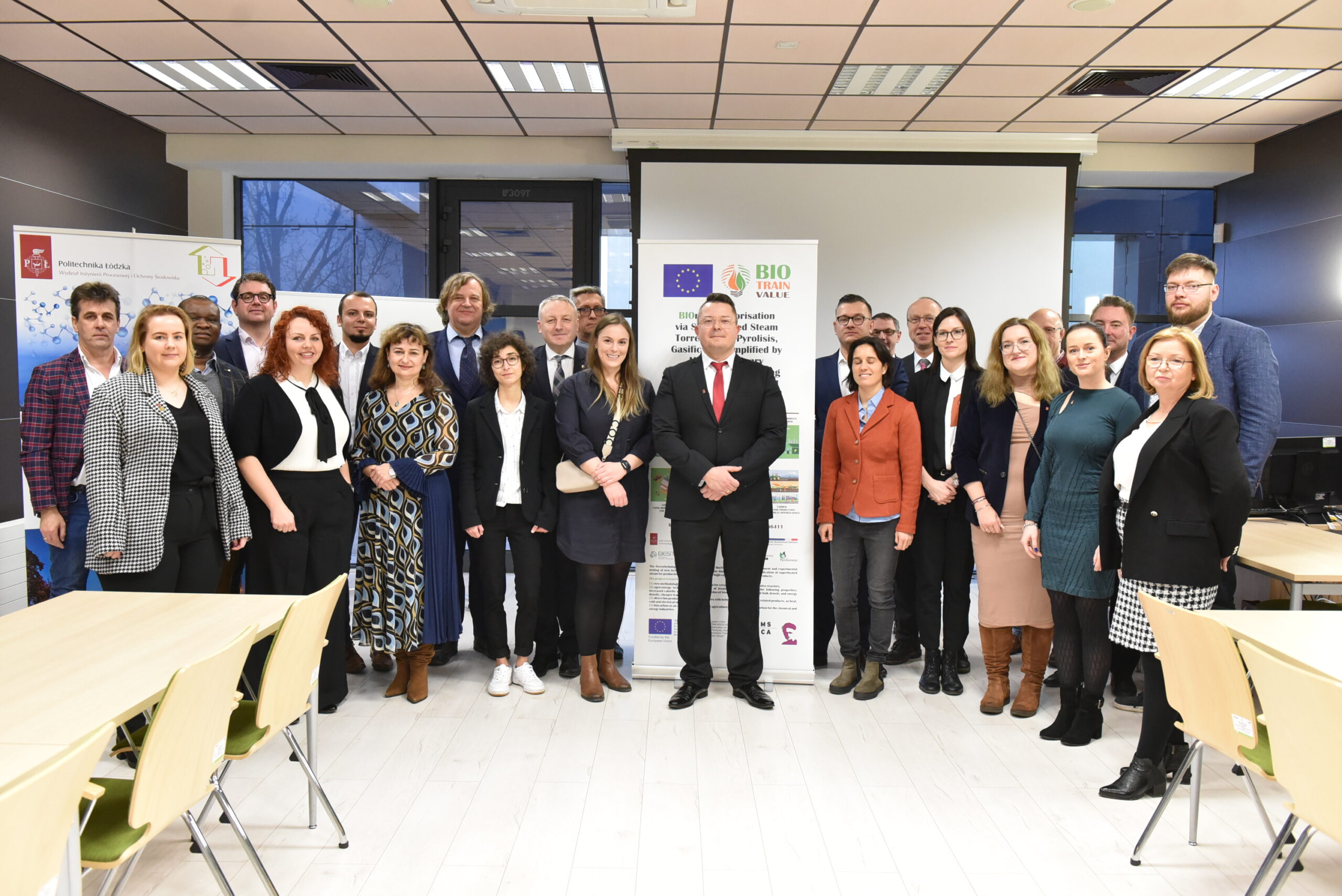
BioTrainValue brings together ten institutions from seven countries, with universities and research institutes working alongside companies. Ideas from the lab are quickly tested against the realities of implementation, and industrial partners bring in problems that usually go unnoticed in an academic setting.
Alongside the coordinator, Lodz University of Technology, Poland is represented by the company APS-Ekoinnowacje. Slovenia is represented by the National Institute of Chemistry in Ljubljana, with the team of Prof. Blaž Likozar and Dr Andrii Kostyniuk, and Greece by the Technical University of Crete in Chania (Prof. Stelios Rozakis, Dr Panagiotis Regkouzas) and BIO2CHP, a company that builds biomass gasification systems. Germany contributes Westsächsische Hochschule Zwickau and Austria the BEST institute (Bioenergy and Sustainable Technologies) in Graz. Ireland is represented by the industrial partner Arigna Fuels, which runs Europe’s largest production line for torrefied biomass. The network is completed by two UK associated partners: Aston University with its Energy and Bioproducts Research Institute, EBRI (Prof. Jude Onwudili, Dr Omar Mohammad), and the company PyroGenesys.
The teams in Łódź and Ljubljana have worked together for several years on a number of projects in parallel, including CARBIOW and SH2AMROCK alongside BioTrainValue. Building lasting relationships of this kind is one of the main aims of MSCA.
What is the research about?
The core process is biomass torrefaction. This is a mild thermal treatment at 200–300°C with limited oxygen, which turns the feedstock into a dark, brittle material with properties close to coal. Torrefied biomass is more energy-dense, hydrophobic and resistant to biodegradation. It grinds easily and is suitable for co-firing or gasification. In the project’s research, its calorific value rises from about 20 to as much as 30 MJ/kg.
What sets BioTrainValue apart is both the medium and the direction of conversion. Instead of inert gases, the team uses superheated steam. Alongside dry torrefaction it is developing a wet, hydrothermal variant run with zeolite catalysts (including H-ZSM-5, H-Beta and H-USY). As a result, the same feedstock yields valuable chemical compounds as well as solid fuel. The products fall into three groups:
- solids: high-calorific torrefied biomass and hydrochar, activated carbon, and biochar as a fertiliser additive
- liquid feedstocks for the chemical industry: levulinic acid, 5-HMF, bioethanol and formic acid
- gases: synthetic biogas and, in the Slovenian strand of the work, hydrogen pathways and green ammonia
The feedstock comes entirely from residues, with no wood felled for the purpose. It includes waste from the pulp and paper industry, olive stones, digestate from biogas plants and sawdust, and in comparative studies also Oxytree, sorghum and coffee waste. The project goes beyond the reaction itself and covers the steps that decide cost-effectiveness and safety: drying biomass before thermal treatment, and techno-economic assessment and life cycle assessment (LCA), supplemented by PESTEL and Monte Carlo analyses.
How is BioTrainValue structured?
The work is divided into five work packages:
- Lodz University of Technology leads project management for the whole duration of the project.
- Together with Arigna Fuels, Lodz University of Technology also leads the redesign of pilot-scale superheated steam torrefaction units and drying equipment.
- The National Institute of Chemistry (with BEST) analyses the bioproducts and their properties for specific uses: solid fuels, fertiliser biochar, activated carbon and biogas technologies. It also assesses the resulting material as a feedstock for pyrolysis and gasification.
- The Technical University of Crete (with APS-Ekoinnowacje and the university in Zwickau) runs research and training in bioeconomy: LCA, PESTEL, Monte Carlo and environmental assessment.
- The fifth package, which involves all partners, covers dissemination and communication.
What has it delivered so far?
The most measurable result is publications. The project has produced 18 peer-reviewed articles, including papers in leading Elsevier journals (Chemical Engineering Journal, Journal of Cleaner Production, Renewable Energy, Energy Conversion and Management). Many are co-authored across institutions, with authors from Poland, Slovenia, Greece and the UK, so the secondments have turned into joint publications. The papers cover the project’s main lines of work. One is wet torrefaction of waste, which yields levulinic acid, 5-HMF and bioethanol together with high-calorific hydrochar. Others are engineering topics such as drying biomass before processing and comparing the dry and wet variants.
It did not stop at publications. Cooperation within the consortium has led to joint patent applications and three new international projects, on topics including green hydrogen and green ammonia.
The second area is conferences and work with industry. The team presented results at CEBC 2026 in Graz (January 2026) and ICORES 2026 in Krynica-Zdrój (May 2026). At the Irish partner Arigna Fuels, the team carried out a techno-economic analysis and an LCA (in SimaPro) of producing torrefied biomass from olive stones and digestate. It also improved process safety by designing a cooling system for the finished product. All required project documents were submitted on time.
TCCB
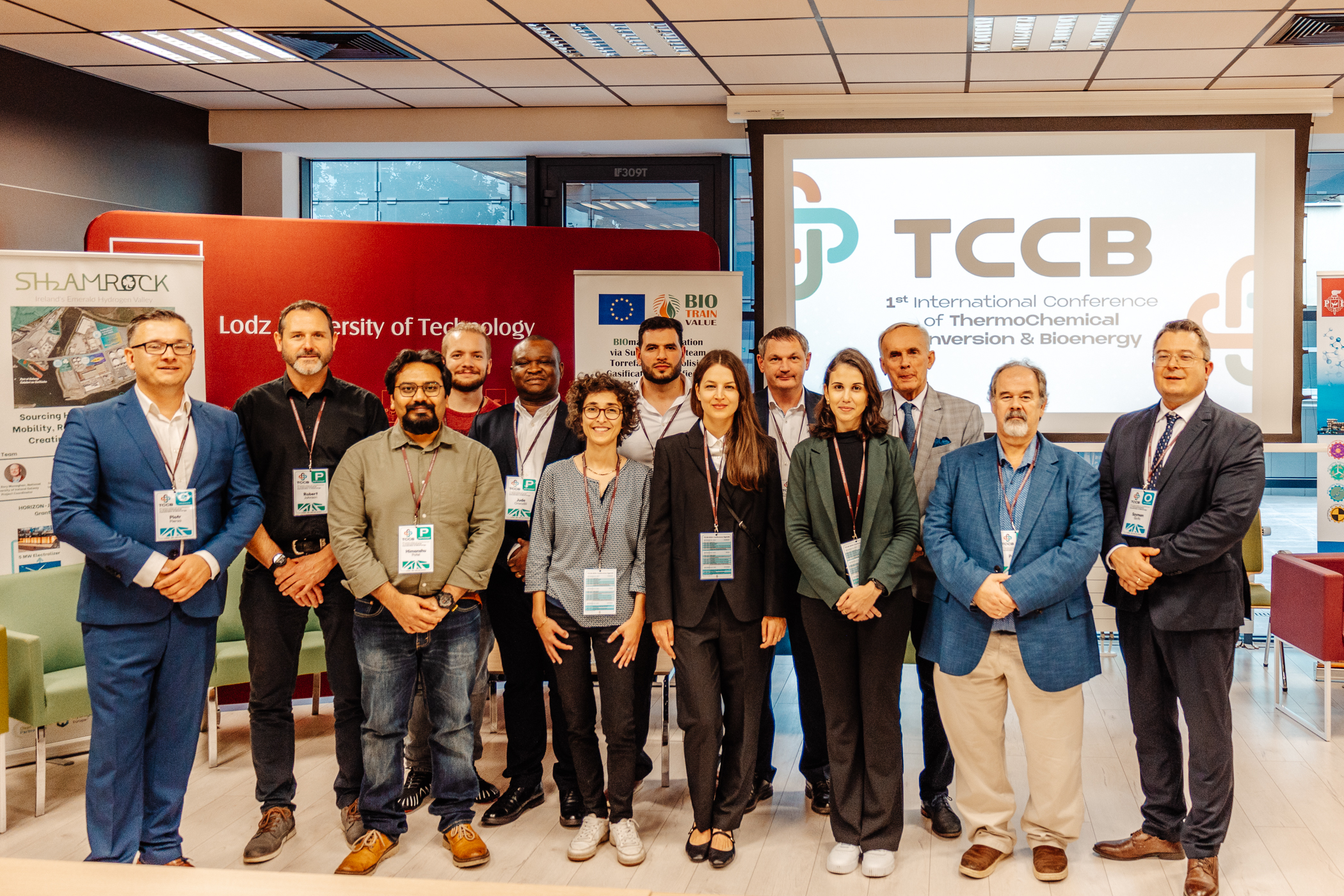
The planned outputs include two international conferences, and these show most clearly how the project reaches beyond its own consortium. The TCCB conference (International Conference of Thermochemical Conversion & Bioenergy) is organised in Łódź by two project partners, Lodz University of Technology and APS-Ekoinnowacje, with support from the NAWA-MSCA Contact Point for Central Poland and the University of Lodz. Its scientific partners include further consortium members: the Technical University of Crete, Westsächsische Hochschule Zwickau, the National Institute of Chemistry, BEST, Arigna Fuels and Aston University. TCCB is in effect an extension of the project, where its results meet the wider research community.
The first edition, TCCB 2024, has already taken place. The second is scheduled for 24–26 September 2026 in Łódź, at the LabFactor building of Lodz University of Technology. The programme has four modules: Thermochemical Conversion Techniques, Hydrogen Technologies, Biomass Conditioning, and Renewable Energy Sources and Circular Economy. In MSCA projects, this is often what lasts longest: a recurring event and the community around it, which carry on after the grant formally ends.
What will BioTrainValue leave behind?
The project’s impact shows at several levels. Environmentally, BioTrainValue fits into the circular economy. It takes residues from sawmills, pulp mills, agriculture and biogas plants, which used to be a disposal problem, and turns them into fuels, chemicals and soil improvers. In the EU classification, the project counts in full as climate action. Economically, it creates new value chains and jobs, and having companies in the consortium means thinking about commercialisation from the start.
Most of the change, however, happens at the level of people and institutions, which is what the European Commission expects from MSCA projects: stronger researchers and lasting connections. Researchers gained practical skills they could not have acquired in their home labs. The main one was running biomass torrefaction at industrial scale, which they learned at partners with the necessary infrastructure. The exchanges have built a strong European network, including centres such as Aston University in the UK and the National Institute of Chemistry in Slovenia, which has already produced joint patents, publications and three new international projects. There has also been a concrete case of intersectoral transfer: the British company PyroGenesys has put a sewage sludge dryer developed at Lodz University of Technology into its pyrolysis technology.
What would not have happened without MSCA? According to the coordinator, above all the secondments themselves and the international conferences. This shows the value of Staff Exchanges well. The scheme funds the movement of people and knowledge, and publications, patents and further grants follow from it. BioTrainValue formally ends on 31 December 2026, but the September TCCB conference and the projects already under way with the same partners show that the people and the relationships will last beyond it.
Project at a glance
- Acronym: BioTrainValue
- Full title: BIOmass Valorisation via Superheated Steam Torrefaction, Pyrolysis, Gasification Amplified by Multidisciplinary Researchers TRAINing for Multiple Energy and Products’ Added VALUEs
- Programme: Horizon Europe, Marie Skłodowska-Curie Actions (MSCA), Staff Exchanges (ENV panel, 2021 call)
- Grant agreement number: 101086411 (DOI: 10.3030/101086411)
- Duration: 1 January 2023 – 31 December 2026
- EU contribution: EUR 993,600
- Coordinator: Lodz University of Technology, Faculty of Process and Environmental Engineering
- Project leader: Prof. Szymon Szufa
- Consortium countries: Poland, Slovenia, Greece, Germany, Austria, Ireland, United Kingdom
- Secondments: more than 40 people, 3 months on average (60% women)
- Publications: 18 peer-reviewed articles
- Project website: biotrainvalue.eu | CORDIS: cordis.europa.eu/project/id/101086411
- TCCB 2026: 24–26 September 2026, Łódź | tccb.pl